

Since 2013, Patriots for Disabled Divers has trained over 1,000 veterans to scuba dive. Our programs help injured veterans embrace the therapeutic benefits of adaptive diving and join the worldwide community of scuba divers. But what exactly do participants do during one of our programs? In this article, we’ll demystify our adaptive diving program. Read on to learn what’s involved in one of our Open Water Diver certification courses.
Qualifying for the Adaptive Diving Program
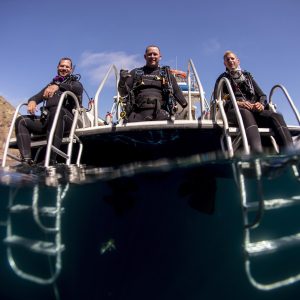 Patriots for Disabled Divers (PFDD) focuses on providing adaptive diving to injured veterans. To qualify for our programs, the applicant must be a veteran with a VA disability rating of at least 30%. Additionally, all applicants must be declared healthy enough to scuba dive. This involves completing the Diver Medical Questionnaire, the same form used throughout the recreational diving industry.
Many participants will need to have their form signed by a qualifying medical professional before acceptance into the program. Qualifying medical professionals include physicians, nurse practitioners, physician’s assistants, and independent duty Navy corpsmen. The signing medical professional may not be the applicant themselves. That said, the physical required is less intensive than a full-blown Navy diver physical or flight physical. As such, most injured veterans meet the health requirements to scuba dive recreationally.
Training Through Your Local PFDD Affiliate
All PFDD diver training is carried out through a local affiliate dive center. These dive centers hold the PADI 5 Star rating and train participants exclusively in PADI courses to ensure the highest quality of adaptive diver training. There is great flexibility in the training schedule and techniques used in PADI programs. This ensures training can be adapted to the individual diver’s needs while maintaining the highest safety standards. However, all training meets the same foundational requirements, which include the following 3 major course sections.
Academics
The program’s academic portion is where participants learn the basic science of diving. This includes primers on diving’s effect on the body, diving equipment, environmental factors, and safety protocols. This portion can occur either before or during the confined water training (see below). Academics are typically completed at home on PADI’s go-at-your-own-pace e-learning platform. However, instructors can provide in-person classroom training as required by the participant’s individual needs.
Confined Water Training
Confined water training is sometimes referred to as “the pool work.” This is the first in-water portion of the course. Here, participants learn how to use the equipment and all the physical skills needed to be a scuba diver within a calm body of water. Most often, this part takes place in a swimming pool, but some natural bodies of water qualify as confined water sites as well. There is a simple swim test completed during confined water training. However, there is no such thing as failure in these courses. Students simply repeat skills until they achieve mastery, with no maximum number of attempts.
Open Water Training
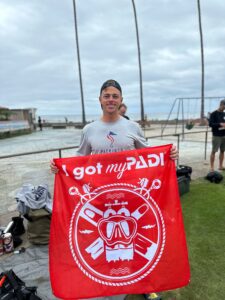 The open water portion of the course allows participants to apply their new skills during four dives in a natural body of water. These dives are conducted under the strict supervision of the instructor. Each dive is treated as a real dive of the kind typical to the local environment. During each dive, the instructor will ask the participants to demonstrate their mastery of several foundational diver skills. However, the focus is to apply what was learned in confined water to real-life diving.
Post Certification
After completing all the performance requirements, participants become certified PADI Open Water Divers. This certification is valid all over the world. It qualifies PFDD participants to dive independently with a buddy, keeping within the limits of their training and experience. This opens most dive sites worldwide, allowing participants to join an international community of scuba divers.
After certification, participants also qualify to join PFDD for other programs, such as our trips to the Georgia Aquarium, where we dive with whale sharks. To learn more about PFDD’s adaptive diving programs or to apply, contact us online or email us at jeff@patriotsfordisableddivers.org.